Home › Kilimanjaro › Marangu
The Roof of Africa · 5,895m
Marangu
The oldest path up Kilimanjaro, and the only one where you sleep in huts rather than tents. Gentlest gradient on the mountain — but also the shortest profile, which is exactly why the summit rate drops.
- Hut accommodation
- Gentlest gradient
- Same path up and down
Tanzanian-Owned Operator
Fair Porter Treatment
Based In Arusha & Moshi
Book Direct, No Middlemen
Be honest with yourself
THE COMFORTABLE ROUTE,
Marangu is the only Kilimanjaro route with permanent huts — wooden dormitories with bunks, mattresses and a dining hall. If camping is the thing stopping you booking, this removes that objection.
But we will not oversell it. Six days gives your body less time to adjust than any other itinerary we run, and the summit rate reflects that honestly: around 85%, against 98% on Lemosho.
- Sleeping huts with bunks and mattresses at every camp
- Same trail ascending and descending — less varied scenery
- Optional extra day at Horombo, which we strongly recommend
Day by day
THE ITINERARY
Altitudes, distances and walking hours for every day on the mountain.
Price from
On request
per person, private group
6 Days
On the mountain
1
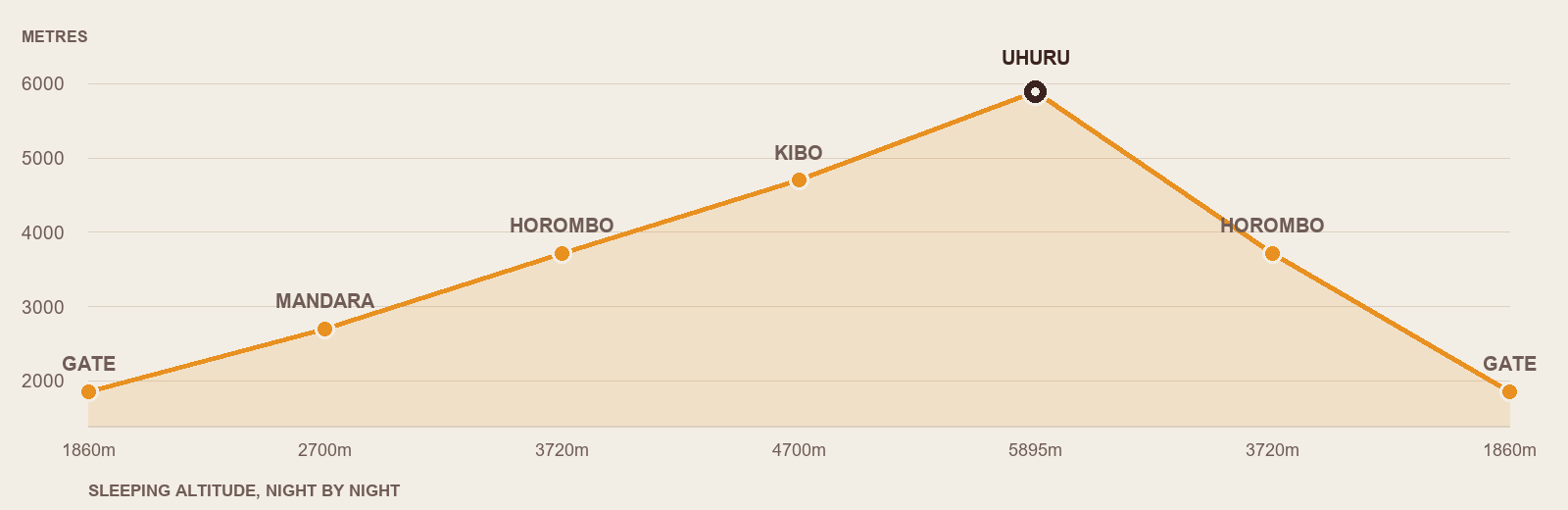
Marangu Gate to Mandara Huts
Register at the gate and climb a well-made forest path through thick montane rainforest to a cluster of A-frame huts in a clearing.
- 1,860m to 2,700m
- 8km
- 4-5 hrs
2
Mandara to Horombo Huts
The forest gives way to open moorland with giant lobelia and groundsel. Wide views over the Kenyan plains at sunset.
- 2,700m to 3,720m
- 12km
- 6-7 hrs
3
Horombo to Kibo Huts
Past the Last Water Point and across the saddle, a wide bleak alpine desert between Mawenzi and Kibo.
- 3,720m to 4,700m
- 9km
- 6-7 hrs
4
Summit Night: Kibo to Uhuru Peak, down to Horombo
Wake at 23:00 for the hardest night of the climb — steep scree to Gilman’s Point, then the rim to Uhuru at 5,895m.
- 5,895m summit
- 22km
- 12-15 hrs
5
Horombo to Marangu Gate
A long but easy descent back through moorland and rainforest, retracing the path you came up. Certificates at the gate.
- 3,720m to 1,860m
- 20km
- 5-6 hrs
6
Departure or safari connection
Transfer to Kilimanjaro International Airport, or carry on to the Serengeti, Ngorongoro or Zanzibar.
- Arusha
- Transfer included
No surprises
WHAT'S IN,
Included
- All park gate, camping and rescue fees
- WFR-certified lead guide, assistant guides, cook and porters
- Three hot meals a day, cooked fresh at camp
- Four-season tents, sleeping mat and heated dining tent
- Twice-daily pulse-oximeter checks and emergency oxygen
- Airport transfers plus two nights' hotel in Arusha
- Filtered drinking water and a summit certificate
Not included
- International flights and Tanzania visa
- Travel and high-altitude medical insurance
- Personal trekking gear — rentals from $10 in Moshi
- Crew tips, budgeted together at your briefing
- Drinks, snacks and souvenirs
- Anything not listed under Included
Make it yours
WORTH ADDING
Small upgrades that make a real difference at 4,600m.
Private Toilet Tent
A clean, private chemical toilet carried and serviced at every high camp by a dedicated crew member.
$150 / group
Extra Personal Porter
A dedicated porter carrying up to 15kg of extra gear or camera equipment, so your daypack stays light.
$140 / trek
Oxygen & WFR First Aid
Portable emergency oxygen cylinders and pulse-oximeters travel with every KissRock group as standard.
Included
Zanzibar Flying Safari
Skip the long drive — fly direct from Seronera or Kilimanjaro Airport straight to Stone Town.
$280 / person
Safety assured
THE MOUNTAIN IS SERIOUS.
Twice-Daily Health Checks
Pulse-oximeter and lung checks every morning and evening, logged by your guide.
Emergency Oxygen
Portable oxygen and a full first-aid kit travel with the crew from gate to summit.
WFR-Certified Guides
Every lead guide holds a current Wilderness First Responder certificate.
Four-Season Camps
Weatherproof tents, insulated mats and a heated dining tent at every camp.
Before you ask
STRAIGHT ANSWERS
How cold does it get on summit night?
Expect −10°C to −20°C at Uhuru Peak with wind chill. A −10°C-rated down jacket, thermal base layers, warm gloves and a balaclava are not optional. All of it can be hired in Moshi.
What is the food like on the mountain?
Three cooked meals a day prepared fresh at camp by our own cook. Vegetarian, vegan, halal and gluten-free are all straightforward — tell us when you book.
How heavy is my daypack?
Porters carry your main duffel, capped at 15kg. You carry a 25–30L daypack with water, snacks, a rain shell, a warm layer and a camera — usually 5–7kg.
Will there be phone signal and charging?
Signal is patchy but present on most of the mountain. There is no mains power, so bring a power bank and sleep with it in your sleeping bag — cold drains batteries fast.
Marangu Route
YOUR WINDOW IS
Send your dates and group size. We confirm availability, send a full kit list and hold your place with a $200 deposit.